How to Draw Faster: 7 Speed Drawing Techniques for Timed Games
Master speed drawing with 7 proven techniques that help you draw faster and better in timed drawing games. Learn how to win 45-second drawing challenges.
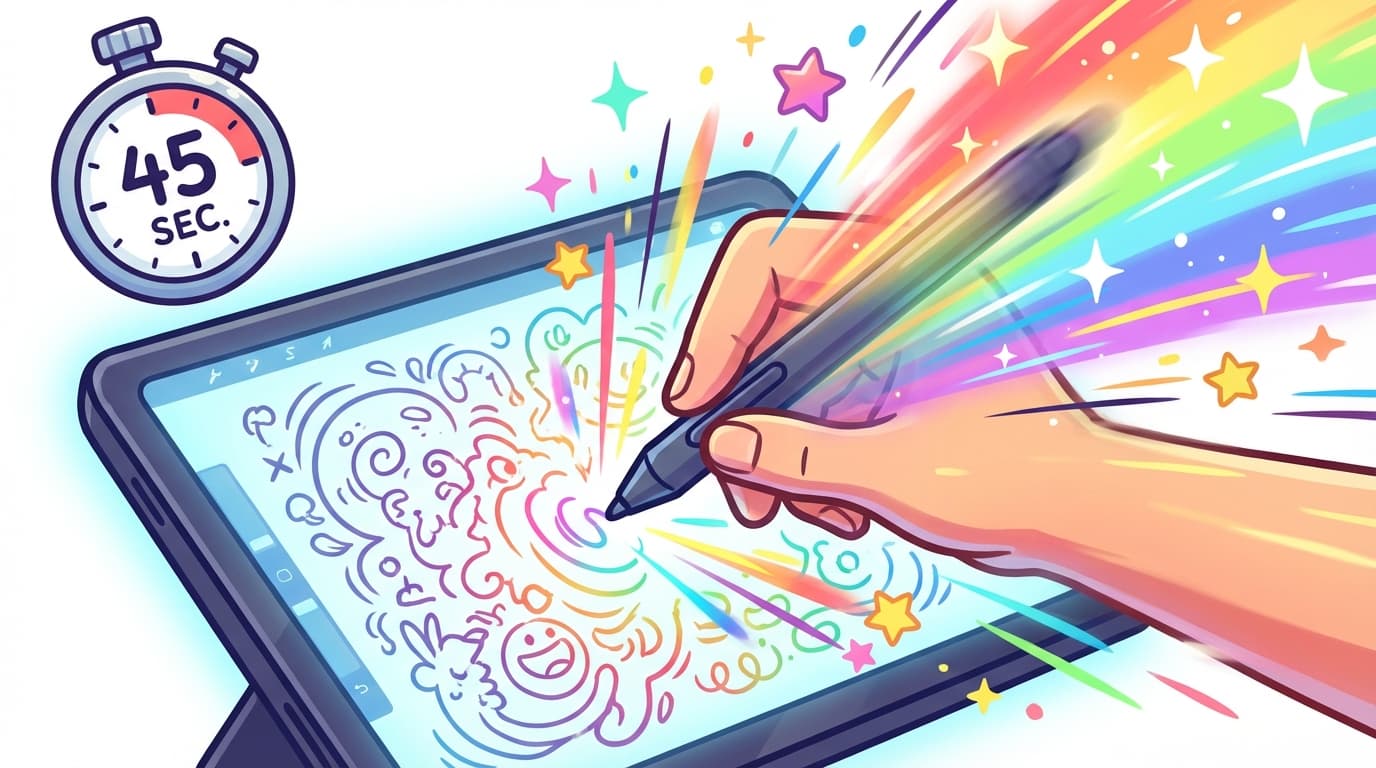
The timer starts. You see the prompt: "elephant." Your mind knows exactly what an elephant looks like, but your hand freezes. Twenty seconds pass and you've barely sketched a circle. Sound familiar?
Drawing under time pressure is a completely different skill than leisurely sketching. In games like Doodle Duel, where you have just 45 seconds to draw recognizable objects, speed matters as much as accuracy. The good news? Speed drawing is a learnable skill, not some mysterious talent.
Whether you're trying to climb the leaderboards or just want to stop embarrassing yourself in front of friends, these seven techniques will transform how you approach timed drawing challenges.
1. Start with Basic Shapes — Always
Professional illustrators don't start with details. They begin with simple geometric shapes that capture the overall form. An elephant? That's a large oval for the body, smaller circle for the head, cylinders for legs, and a curved line for the trunk.
This "construction drawing" approach gives you two massive advantages in timed games:
- Immediate recognizability: Even if you run out of time, basic shapes convey the subject
- Proper proportions: You nail the overall structure before worrying about details
Think of it like building a house—you need the frame before you add windows and paint. In a 45-second round, that solid frame might be all you have time for, and that's often enough for the AI judge to recognize your subject.
2. Draw with Your Shoulder, Not Your Wrist
This is the single most game-changing tip for speed drawing. Most people draw like they write—making tiny controlled movements from the wrist. That's fine for details, but it's painfully slow for larger strokes.
Professional artists draw from their shoulder and elbow for bigger movements. This allows for:
- Faster, more confident lines
- Smoother curves without the "chicken scratch" effect
- Less fatigue during extended play sessions
Try it right now: make a large circle using only your wrist. Now make one using your whole arm. Feel the difference? That second one is not only faster but usually looks more confident too.
3. Focus on Distinctive Features First
When time is limited, you can't draw everything. The trick is knowing what matters most for recognition. Every subject has 2-3 distinctive features that make it instantly identifiable.
For an elephant, it's the trunk and large ears. For a guitar, it's the body shape and neck. For a bicycle, it's two circles and a handlebar. Master these key features, and the AI (and human players) will recognize your drawing even if everything else is rough.
This is why practicing in Solo Arcade mode is so valuable—you learn which features the AI prioritizes for different objects. That knowledge translates directly to competitive play.
4. Use Confident, Continuous Lines
Hesitant, sketchy lines waste precious seconds and make your drawings look uncertain. The AI judge in Doodle Duel (and human observers) respond better to confident strokes, even if they're not perfectly accurate.
Practice "committing" to your lines. Instead of making five tentative marks hoping one looks right, make one bold stroke. If it's wrong, you can quickly add another—but you'll be surprised how often that first confident line is better than you expected.
A rough but confident drawing at 40 seconds beats a perfect but incomplete drawing every time.
5. Practice Gesture Drawing Exercises
Gesture drawing is an old art school exercise where you sketch subjects in 30-60 seconds, capturing movement and form without details. It's essentially what every timed drawing game requires.
Set a timer and practice drawing everyday objects in 45 seconds:
- A coffee mug
- Your pet (if they'll sit still!)
- A chair
- Your phone
- A plant
Do this for 10 minutes daily, and you'll notice dramatic improvements within a week. The Solo Mode in Doodle Duel works perfectly for this kind of focused practice—you get random prompts and immediate AI feedback.
6. Simplify, Simplify, Simplify
Your goal isn't to create museum-quality art. It's to communicate the subject clearly in minimal time. That means ruthlessly eliminating unnecessary details.
Ask yourself: "What's the absolute minimum I need to draw for this to be recognizable?" Usually, it's less than you think. A cat can be an oval body, triangle ears, and whiskers. A house can be a square with a triangle roof and a rectangle door.
The best timed-game artists aren't necessarily the most skilled at realistic drawing—they're the best at smart simplification. They understand visual language: which shortcuts still communicate effectively.
7. Build Subject-Specific Muscle Memory
After playing hundreds of rounds of Doodle Duel, certain prompts become automatic. You've drawn "dog" so many times that your hand knows the movements before your brain fully processes the word.
This muscle memory is gold in competitive play. Build it by:
- Repeating common subjects: Animals, vehicles, household objects appear frequently
- Creating mental templates: Have a "default" approach for categories (e.g., all four-legged animals start the same way)
- Consistent practice: Playing daily builds familiarity with the game's prompt library
Check the game's 34 genres to understand the variety of prompts you might encounter, then practice the most common categories.
From Techniques to Victory
Speed drawing isn't about natural talent—it's about smart techniques and deliberate practice. Start with basic shapes, draw from your shoulder, prioritize distinctive features, commit to confident lines, practice gesture drawing, embrace simplification, and build muscle memory.
The only way to truly master these techniques is through practice. Fortunately, that practice can be fun. Jump into a Solo Arcade session right now and apply these techniques to your next 50 levels. Or create a room and challenge friends to see who can implement these tips most effectively.
The timer's ticking. Time to draw faster.
Enjoyed this article?
Ready to Draw?
Put your skills to the test in a real-time drawing duel. No sign-up needed!
Related Articles

Office Team Building Games That Actually Work (2026 Guide)
Tired of forced team building activities that make everyone uncomfortable? This guide reveals office team building games that actually strengthen communication, boost morale, and work for remote, hybrid, and in-person teams—without the awkwardness.
Read more
Best Games for Thanksgiving with Family (No Setup Required)
Planning your Thanksgiving celebration? Skip the complicated setup and dive straight into the fun with these no-prep games perfect for the whole family. Whether you're gathering in person or connecting virtually with relatives across the country, these games bring everyone together for laughter, gratitude, and unforgettable memories.
Read more
Best Drawing Games for Kids Online: Safe & Fun Options (2026)
Looking for safe and entertaining drawing games for kids? We've curated the best online drawing games that are completely free, work in any browser, and are perfect for children ages 6-14. From creative art studios to AI-powered drawing competitions, these games spark creativity while keeping kids engaged.
Read more